
Light vs Medium vs Heavy Duty Castors: Which Capacity for Your NZ Equipment?
- May 19
- 8 min read
Choosing the wrong duty rating is the most common, and most costly, castor mistake. This guide explains exactly how to calculate what you need, what each tier covers, and which Vartec Industrial product range is right for your application.

What is the difference between light, medium, and heavy duty castors?
Light duty castors handle 10–150 kg per castor and suit office furniture, display stands, and light retail equipment.
Medium duty castors handle 150–400 kg per castor and are used on warehouse trolleys, workbenches, and commercial service equipment.
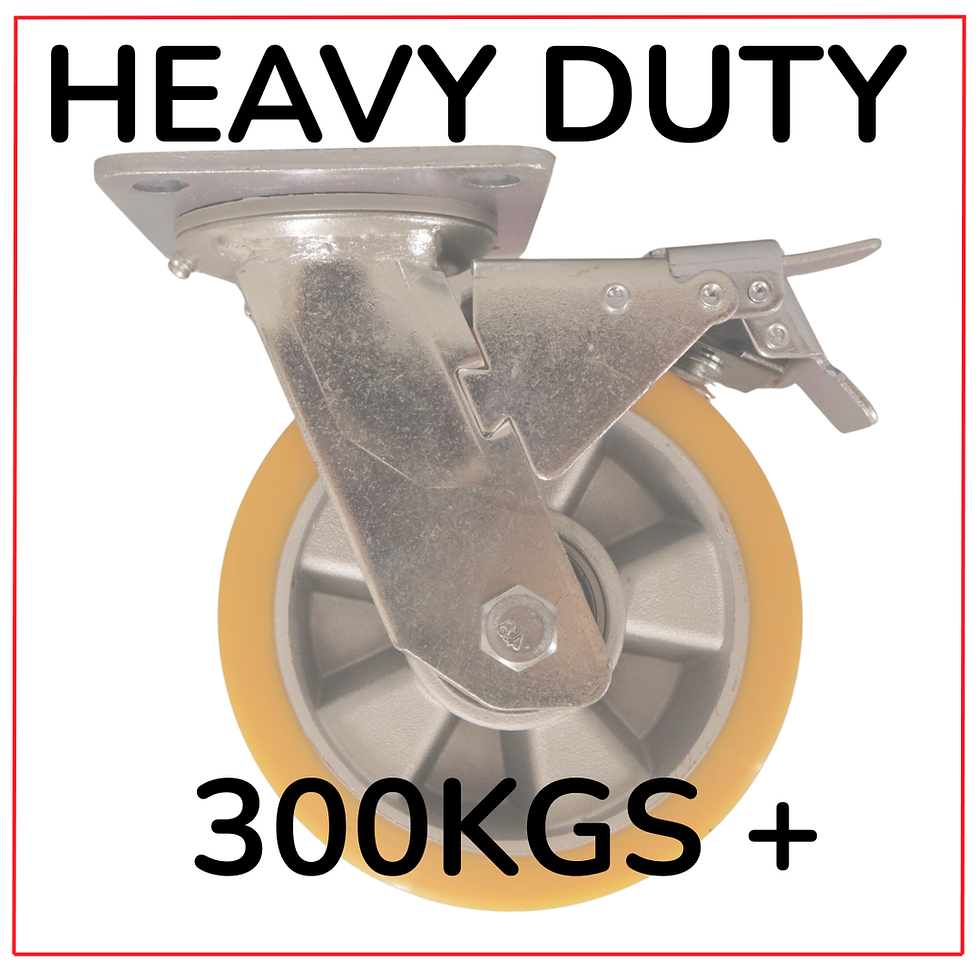
Heavy duty castors handle 400 kg to 1,800 kg+ per castor and are specified for industrial machinery, boat cradles, aviation ground support equipment, and waste handling systems. To find the correct duty rating, divide your equipment's maximum total weight by the number of castors, then multiply by 1.25 as a safety margin.
Walk into any New Zealand workshop, warehouse, hospital, or boat yard and you'll find castors at work. But not all castors are created equal and the single most common cause of premature castor failure we see at Vartec Industrial is using an under-rated product for the application. Under-spec castors wear out faster, roll harder, and eventually fail — creating safety hazards and unexpected replacement costs.
This guide cuts through the confusion. We explain what each duty tier actually means, give you a simple load calculation formula you can use today, and map every Vartec Industrial product range to the right application. Whether you're fitting out a retail display, equipping a workshop in Whangarei, or building a vessel cradle for a Tauranga boat yard, this guide tells you exactly what you need.
The Three Duty Tiers: What Each One Covers
Castor duty ratings aren't arbitrary marketing categories, they reflect the real engineering differences in hub material, wheel compound, bearing specification, and fork construction. Here's what distinguishes each tier in practice:
|
|
|


How to Calculate the Right Load Rating
The biggest source of confusion in castor selection is that people compare the total equipment weight to the castor's rated load — but that's not how it works. The load rating applies per castor, not across all four. Here's the correct formula:
Load Rating Formula
Step 1: Find total maximum weight (equipment + contents)
Total Weight = Equipment kg + Max Load kg
Step 2: Divide by number of castors (typically 4)
Per-Castor Load = Total Weight ÷ Number of Castors
Step 3: Apply 25% safety margin
Minimum Rating = Per-Castor Load × 1.25
Select the next castor rated ABOVE this number
Example 1 — Office Chair
Chair + person = 120 kg
120 ÷ 5 castors = 24 kg
× 1.25 = 30 kg minimum
→ Light Duty
Example 2 — Workshop Trolley
Trolley + tools = 480 kg
480 ÷ 4 castors = 120 kg
× 1.25 = 150 kg minimum
→ Medium Duty
Example 3 — Boat Cradle
Vessel + cradle = 2,400 kg
2,400 ÷ 6 castors = 400 kg
× 1.25 = 500 kg minimum
→ Heavy Duty
Always calculate to the maximum possible load — not the average or typical load. Equipment that is usually half-full but can occasionally be loaded to capacity must be rated for the full capacity figure. The safety margin exists to account for load spikes, impact forces, and surface irregularities.
Load per castor | 10–150 kg | 150–400 kg | 350–800 kg | 650–1,800 kg |
Typical wheel material | TPR, nylon, rubber | Rubber, PU on plastic | PU on alloy/cast iron | PU wide-profile cast iron |
Fork construction | Light pressed steel / plastic | Reinforced pressed steel | Heavy pressed steel + ZP | Heavy cast fork assembly |
Bearing type | Plain bearing / single ball | Single / double ball bearing | Double ball bearing | Heavy double ball bearing |
Typical wheel diameter | 25mm – 100mm | 80mm – 150mm | 100mm – 200mm | 85mm – 250mm |
Floor-safe (non-marking) | Yes (most) | Yes (PU/rubber types) | Yes (PU types) | Yes (PU tyre) |
Braked option available | Selected models | Yes, most ranges | Yes, all ranges | Yes, incl. jacking plate |
Suitable for wet / marine | No | Limited | Yes (zinc-plated fork) | Yes (zinc-plated fork) |
Load per castor | 10–150 kg | 150–400 kg | 350–800 kg | 650–1,800 kg |
Which Industries Use Which Duty Rating?
Duty rating follows application. The environments and industries below are a guide to what we see specified most frequently across New Zealand's commercial and industrial sectors.
Light Duty Applications | Medium Duty Applications | Heavy Duty Applications |
|
|
|
The 3 Most Expensive Castor Mistakes in NZ
After years of supplying castors to NZ businesses, these are the three mistakes we see most often and the ones that cost the most to fix:
Mistake 1 - Comparing total equipment weight to the per-castor rating. The most common error. If your trolley weighs 600 kg and you see a castor rated at 200 kg, you might think four is enough (4 × 200 = 800). But that ignores the safety margin, load spikes, and the fact that weight is rarely distributed perfectly across all four wheels. Always apply the formula: divide total weight by castor count, then multiply by 1.25.
Mistake 2 - Choosing by price instead of specification. A cheap light-duty castor on a heavy workbench doesn't save money, it fails quickly, damages floors, and may cause a workplace injury. In NZ commercial and industrial settings, castor failure is a legitimate Health and Safety at Work Act liability. The per-unit cost difference between light and heavy duty is small; the cost of failure is not.
Mistake 3 - Ignoring the environment. A castor rated correctly for load can still fail prematurely if the wrong wheel material is specified for the floor surface or environment. Cast iron wheels on polished hospital floors will mark and crack the surface. TPR wheels in a hot workshop near ovens will degrade rapidly. Non-marking polyurethane in a marine yard with salt spray needs regular inspection. Match wheel material to environment as carefully as you match load rating to weight.
Why NZ Businesses Choose Vartec Industrial
🏪 Auckland Showrooms - See Before You Buy
Two Auckland locations, Albany (Rosedale) and Papatoetoe, where you can inspect products, discuss your application, and collect same-day. No guesswork from a product photo.
📦 NZ-Wide Delivery - Fast & Tracked
Order online or by phone for fast courier delivery to workshops, boat yards, warehouses, and hospitals throughout New Zealand. Freight calculated transparently at checkout.
🔧 Free Specification Support
Not sure which range to choose? Call or email our Auckland team. We'll work through your load calculation, surface type, and environment with you, at no charge.
💲Broadest Range in NZ - One Supplier
From 10 kg office castors to 1,800 kg marine cradle castors, all from one supplier. Volume pricing available for trade accounts and project quantities.
Castor Duty Ratings FAQs
Common questions from NZ businesses, tradespeople, and procurement teams about selecting the right castor capacity for their equipment.
What is the difference between light duty, medium duty, and heavy duty castors?
Light duty castors (10–150 kg per castor) use thermoplastic rubber, nylon, or small rubber wheels on slim pressed steel or plastic forks. They suit office chairs, display stands, retail fixtures, and light healthcare trolleys.
Medium duty castors (150–400 kg per castor) use rubber, nylon, or polyurethane wheels on reinforced pressed steel forks with ball bearing swivel heads. They're used on warehouse trolleys, workbenches, catering equipment, and commercial service carts.
Heavy duty castors (400–1,800 kg+ per castor) use cast iron, aluminium, or solid nylon hub wheels on heavy-gauge zinc-plated fork assemblies with double ball bearing swivels. They're specified for marine vessel cradles, aviation GSE, industrial machinery, and waste handling equipment.
How do I calculate what duty rating castor I need for my NZ equipment?
Use this four-step formula: (1) Establish the maximum total weight of your equipment including full contents. (2) Divide by the number of castors, typically 4. (3) Multiply the result by 1.25 to build in a 25% safety margin for load spikes and uneven distribution. (4) Select the next product rated above that figure. For example: a 600 kg loaded trolley on 4 castors = 600 ÷ 4 = 150 kg × 1.25 = 187.5 kg minimum per castor, lower medium duty range. If in doubt, call the Vartec Industrial team in Auckland for free specification advice.
Where can I buy light, medium, or heavy duty castors in Auckland or near me in NZ?
Vartec Industrial stocks the full range of light, medium, and heavy duty castors across all load ratings from two Auckland showroom locations: the Albany Showroom at 70 Paul Matthews Road, Rosedale (call 09 444 1335), and the Papatoetoe Showroom at Calmac Engineering, 739 Great South Road (09 270 2097).
Both showrooms offer same-day collection and in-person product advice. You can also order the full range online at vartecindustrial.co.nz with fast tracked courier delivery to any NZ address, including workshops, warehouses, boat yards, and hospitals throughout Auckland, Hamilton, Tauranga, Wellington, Christchurch, and Queenstown.
What happens if you use the wrong duty rating castor on your equipment?
Using an under-rated castor causes accelerated wear on the wheel compound and swivel bearing, increased rolling resistance (making equipment harder and more dangerous to push), deformation of the wheel under sustained load, and ultimately structural failure of the fork assembly — which is a direct safety hazard.
In New Zealand commercial and industrial workplaces, using equipment that fails due to under-specified components may constitute a breach of obligations under the Health and Safety at Work Act 2015, exposing the business to liability. It also voids any warranty on the castor. Always err on the next load rating up rather than on the limit of a lower tier.
What are the best heavy duty castors for industrial and workshop use in NZ?
For heavy duty industrial and workshop applications in New Zealand, the most commonly specified castors from Vartec Industrial are: the UC range (polyurethane on cast iron hub, 350–800 kg) for marine workshops and fabrication tables; the US range (wide-profile PU cast iron, 650–1,800 kg) for large vessel cradles and hardstand equipment; the NU range (solid nylon, 300–500 kg) for abrasive workshop and aviation cargo surfaces; the AU range (polyurethane on aluminium, 300–450 kg) for aviation and non-marking floor applications; the CI range (cast iron wheel, 280–430 kg) for general heavy industrial use; and the HT range (phenolic, 125–480 kg, rated to +280°C) for oven, kiln, and high-temperature industrial environments. All are available in Auckland with NZ-wide delivery.
Still Not Sure Which Duty Rating You Need?
Our Auckland team can help you calculate your load requirements and specify the right castor for any NZ application, free of charge. Contact us or visit either showroom.


Comments