
How to Choose the Right Castor Wheels – A Quick Buying Guide
- Vartec Industrial
- May 12
- 4 min read
There are a lot of castor wheels on the market, and a lot of different advice about how to choose them. Here’s a practical guide that actually helps you make a good decision — whether you’re replacing worn out wheels or setting something up from scratch.

Start With Three Questions
What’s the maximum load? Total weight of the thing you’re moving, divided by the number of castors, plus a safety buffer.
What surface will it be used on? Smooth concrete, hardwood, carpet, rough outdoor surfaces — the answer changes the ideal wheel material.
Does it need to be lockable? If the equipment needs to stay put (workbenches, equipment in use, anything on a slope), you need a locking castor.
Everything else – size, material, brand – follows from those three answers.
Matching Load to Castor Rating
This trips people up more than anything else. The load rating on a castor is per wheel, not per set.
So if you’re buying four castors for a cart that’ll carry 300kg:
Per castor load = 300 ÷ 4 = 75kg
With a 1.3 safety factor = roughly 100kg per castor minimum
The safety factor matters because loads are rarely perfectly distributed across four castors. When you push a trolley and it tips slightly, two castors take more than their share of the load. The factor accounts for this.
For industrial or frequent-use applications, increase the safety factor to 1.5 or higher.
Wheel Material and Surface – The Quick Reference
Surface | Recommended Wheel Material |
Smooth concrete or tile | Polyurethane or nylon |
Hardwood or timber floors | Soft polyurethane or rubber |
Carpet | Standard nylon or hard plastic |
Rough concrete or outdoor | Nylon or solid rubber |
High temperature environments | High-temp rated wheels |
Wet or chemical environments | Stainless steel or specialist materials |
Polyurethane sits in a useful middle ground – it handles a wide range of surfaces, protects floors, and manages decent loads. It’s often the right call when you’re not sure.
Castor Mounting Types
There are two main ways castors attach to whatever you’re mounting them on:
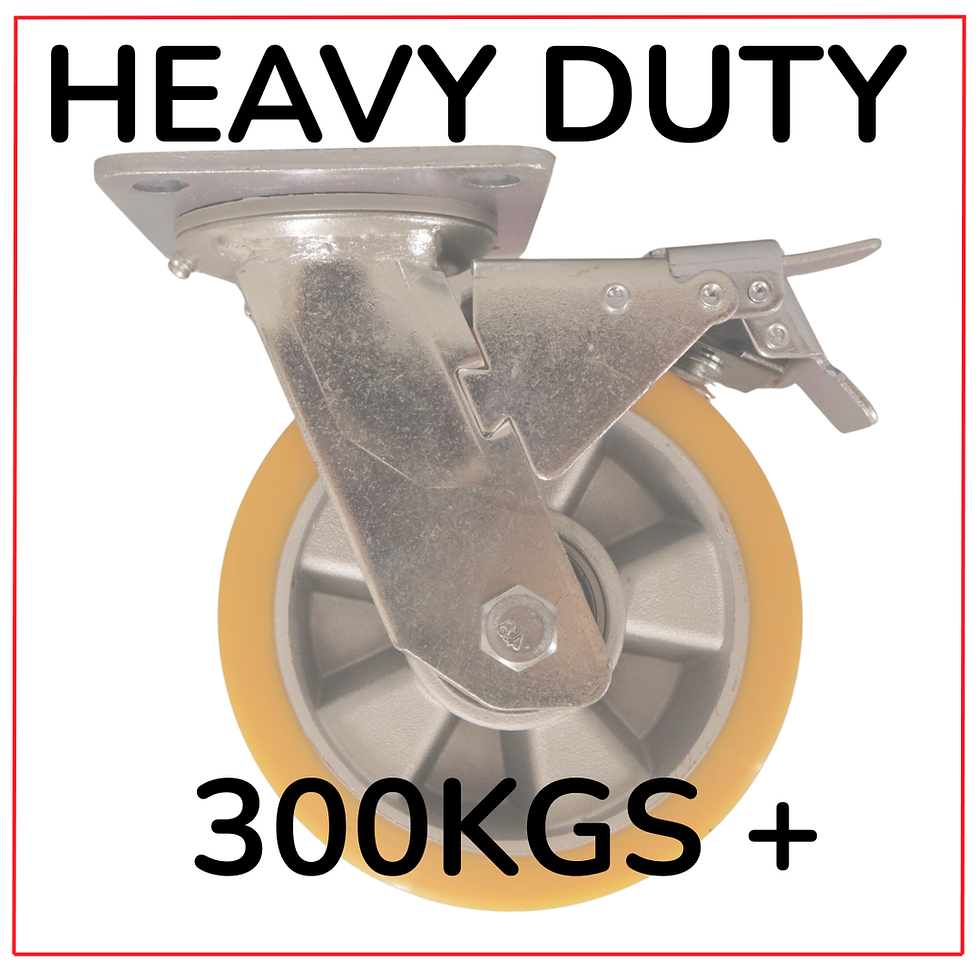
Plate mount (top plate): A square or rectangular metal plate with four bolt holes. This is the most secure mounting option and is what you want for heavy duty use, trolley carts, workbenches, and DIY builds.
Stem mount: A stem (usually threaded or grip-ring) that inserts into a socket on the underside of the furniture or equipment. Standard for most office chairs and lighter furniture. Quick to install and replace, but not suited for heavy loads.
If you’re replacing a castor, match the mounting type and size of your existing one. For plate mounts, measure the bolt hole spacing. For stem mounts, measure the stem diameter and length.
Wheel Diameter – Bigger Rolls Easier
A larger wheel diameter rolls more easily over surface imperfections and requires less pushing force under load. For most workshop or warehouse trolleys, 100–150mm wheels are a good range. For lighter furniture and office use, 50–75mm is standard.
Don’t go smaller than the job needs. Small wheels on rough surfaces or heavy loads wear out quickly and make the equipment much harder to use.

Types of Locks – Choosing the Right One
Not all locking castors work the same way:
Wheel brake lock — stops the wheel rolling. Common on trolleys and carts. Works well on flat surfaces. Doesn’t stop the swivel mechanism.
Swivel lock — locks the castor so it can only roll in one direction. Good for keeping a trolley tracking straight.
Total lock (dual lock) — locks both wheel and swivel. Best option when the equipment must not move at all — workbenches, display units, anything stationary under load.
For workbenches and heavy equipment, total lock is worth the extra cost.

Polyurethane Castors – Worth the Upgrade?
If you’re deciding between standard nylon and polyurethane, yes — in most cases.
Polyurethane castors:
Are quieter in operation
Protect floor surfaces better (no floor marking)
Handle a wider range of loads
Last longer under regular use
The cost difference is usually modest, and the performance difference is noticeable. For home, office, and most workshop applications, polyurethane is the go-to.
Where Things Go Wrong – Common Mistakes
Buying for the average load, not the max. Castors are at most risk during loading and unloading, when loads may be unevenly distributed. Always rate for the worst case.
Ignoring the floor. A castor that’s fine on concrete will destroy a timber floor. Check your surface and match the wheel hardness to it.
Mixing castor heights. If you mix different castor sizes on the same piece of equipment, it’ll rock or sit unevenly. Keep all four castors the same height.
Using stem castors for heavy loads. Plate-mount castors are significantly more secure. For anything over 80–100kg per castor, use plate mounts.

Get Help Choosing
If you’re not sure where to start, Vartec Industrial stocks a comprehensive range of castors and wheels across all duty levels, materials, and mounting types.
Our showrooms in Albany and Papatoetoe (at Calmac Engineering) are set up so you can see the range in person – and our team knows the stock.
We supply trade and direct to public, so come in, bring your old castors if you have them, and we’ll help you find the right fit.


Comments